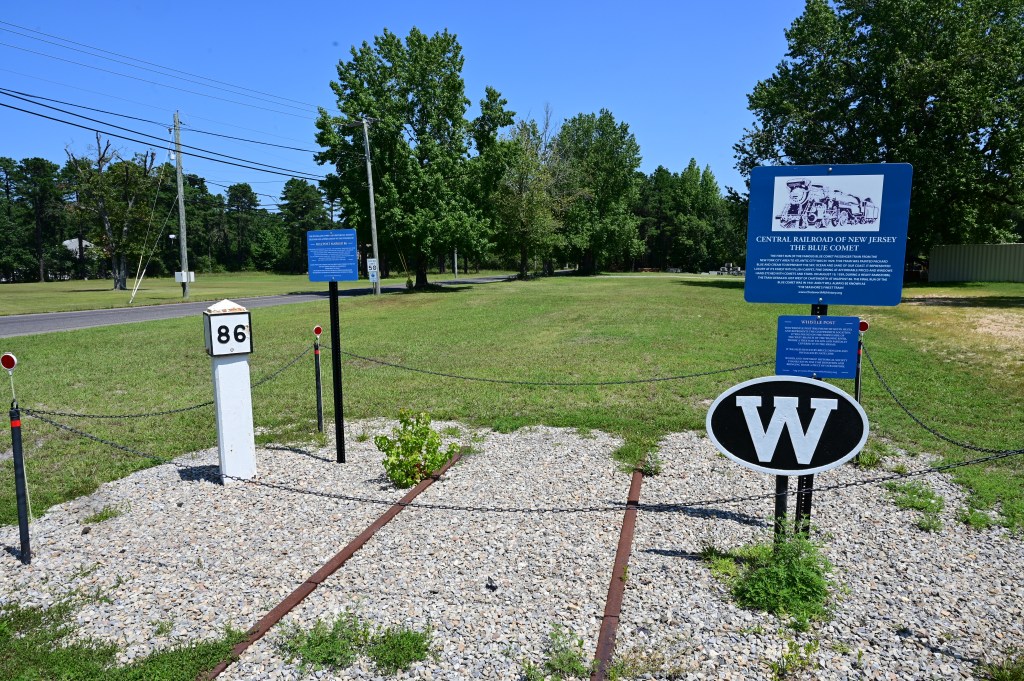
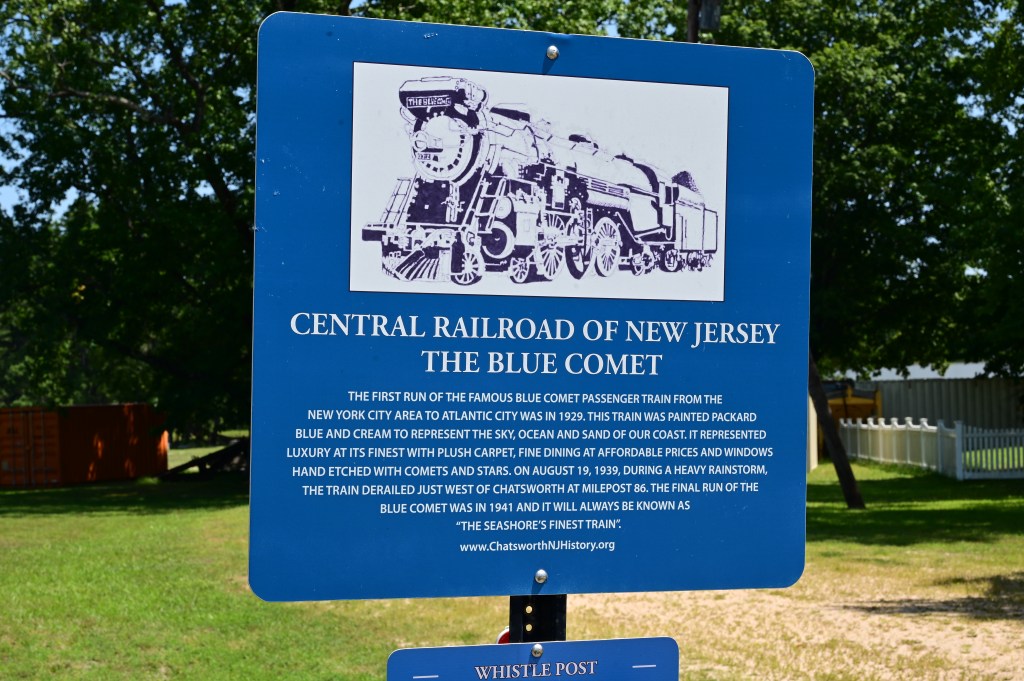
The Blue Comet, also known as the “Seashore’s Finest Train,” was a blue colored train in service from 1929 to 1941 traveling from the New York area to Atlantic City. The train was also known for making 3-hour express trips between Jersey City to Atlantic City, which was extremely quick for the time. The Blue Comet was designed to have a luxury feel but with affordable prices to travelers Furthermore, the train was considered extremely reliable. It ran on time about 97 percent of the time. The blue comet held 16 cars, which were all named after various comets. The cars were painted a Packard blue to represent the sky, a royal blue for the sea, and a cream for the Jersey beaches. On the train’s glass, there were etched designed of a comet, starts, and clouds. The blue comet was fashionable and unique train to ride.
Although, the train wasn’t just for passengers. People from all over drove to see the train pass by. The train was also important to the local folks of Chatsworth. Local paperboys would wait for train’s crewmen to throw the newspapers, including The Camden Courier and The Philadelphia Evening Bulletin, from the train. The local paperboys would then retrieve the newspapers and sell them throughout the town. As Chatsworth was a in remote part of the Pine Barrens, the newspapers were the community’s connection to larger world.

On August 19, 1939, the Blue Comet wrecked at Chatsworth Mile 86. On that day, there was an estimated 13.5 inches of rain, causing an extremely dangerous conditions for travel. With all the rain, the soil under the tracks washed away. As a result, five cars on the train were derailed. Many citizens and emergency response squads of Chatsworth and South Jersey rushed to the tracks to help those injured in the train wreck. There 32 passengers injured. Most of the injuries were minor. However, it was reported that the train’s chef, Joseph Coleman, may have ended up dying from his injuries. After the wreck, the train ran two more years. However, due to the growing popular of automobiles, the Blue Comet was shut down in 1941.

In Chatsworth, there is a historic marker to remember the Blue Comet and it’s derailment. At the site, visitors spot some of the remaining train tracks. There is also some signage remembering the history of train and significant of the train to Chatsworth. If driving down the shore, it might be worth the slower and more scenic drive through Chatworth. If you want to stop to see the train tracks, there is a little dirt parking lot across the street from the site. It’s a quick stop but extremely unique.
Resources
“’Blue Comet Jumps Rails in Jersey.’ The Daily Journal (Vineland, NJ), Aug 21, 1939. https://www.newspapers.com/article/the-daily-journal-blue-comet-jumps-rails/30553479/
Carbone,Mariel. “The 1939 wreck of the Blue Comet is marked in Woodland.” Burlington County Times. Burlington County Times, August 12, 2014. https://www.burlingtoncountytimes.com/story/lifestyle/2014/08/12/the-1939-wreck-blue-comet/17512023007/
Fayer, Ellen V and Stan Fayer and Walter A Brower. Images of America Chatsworth: Capital of the Pine Barrens. United States: Arcadia Pub., 2010. https://www.google.com/books/edition/Chatsworth/FgBeCljsM3oC?hl=en&gbpv=0
Riley, Karen F. Images of America: The Pine Barrens of New Jersey. United States: Arcadia Publishing Incorporated, 2010. https://www.google.com/books/edition/The_Pine_Barrens_of_New_Jersey/Trmu2Wxs4_cC?hl=en&gbpv=0 Waltzer, Jim and Tom Wilk. Tales of South Jersey: Profiles and Personalities. New Brunswick: Rutgers University Press, 2001. https://www.google.com/books/edition/Tales_of_South_Jersey/FoGKfZqdLlMC?hl=en&gbpv=0
 New Jersey History and Sites
Leave a comment